PCA9546 4-Channel Stemma QT/Qwiic I2C Multiplexer - TCA9546A Compatible Ada 5664
PCA9546 4-Channel Stemma QT/Qwiic I2C Multiplexer - TCA9546A Compatible Ada 5664
You've just found the perfect I2C sensor available in a handy Qwiic or STEMMA QT package, and you want to connect two or three or four of them to your microcontroller when you realize, "Uh oh, this chip has a fixed I2C address, and from what I know about I2C, you can't have two devices with the same address on the same SDA/. SCL-Pins have en!" Are you without luck? You would be if you didn't have this ultra-cool Adafruit PCA9546 4-channel STEMMA QT / Qwiic I2C multiplexer. Finally, one way is to get up to 4 I2C devices with the same address connected to a microcontroller - this multiplexer acts as a gatekeeper that routes the commands with your command to the selected I2C port. If you need to have up to 8 multiplex devices, check out the 8-channel PCA9548 version of this board. If you're wondering why this uses the PCA9546 and not the TCA9546A, the PCA9546 is the "Braternal Twin Sister" of the TCA9546, but is easier to get during the big chip shortage of 2022. It works exactly the same, just can't sink to 1.8V power, which is fine because QT boards are only 3V or 5V anyway. You can still use any sample code or library for the TCA9546 or TCA9548. The use is pretty straightforward: the multiplexer itself is located on the I2C address 0x70 (but can be adjusted from 0x70 to 0x77 with jumpers on the back) and you simply write a single byte with the desired multiplexte with the desired multiplext. ED output number to this port and Bam - all future I2C packets will be sent to this port. Theoretically, you could have 8 of these multiplexers on each of the 0x70-0x77 addresses to control 4x8 = 32 of the same I2C addressed part. The Adafruit STEMMA QT / Qwiic PCA9546 Breakout - 4 Channels has five JST SH 1mm ports: 1 input and 4 outputs. There is a connector at the end that connects to your I2C controller (there are also breadboard breakout pins if you need them). Use this breakout to add as many I2C devices to the bus as you need. Complete with mounting holes so the board can be adapted to any system. A small power LED lets you know that the hub board has connectivity. There is even a built-in 3.3V 500mA regulator. So if you use this with a 5V microcontroller like an Arduino 328, you can move all QT ports to 3V power and logic level. Simply trim/solder the jumper on the bottom of the PCB to change the power and logic level to force 3V.
Product Features
- You've just found the perfect I2C sensor available in a handy Qwiic or STEMMA QT package, and you want to connect two or three or four of them to your microcontroller when you realize, "Uh oh, this chip has a fixed I2C address, and from what I know about I2C, you can't have two devices with the same address on the same SDA/. SCL-Pins have en!" Are you without luck? You would be if you didn't have this ultra-cool Adafruit PCA9546 4-channel STEMMA QT / Qwiic I2C multiplexer
- Finally, one way is to get up to 4 I2C devices with the same address connected to a microcontroller - this multiplexer acts as a gatekeeper that routes the commands with your command to the selected I2C port. If you need to have up to 8 multiplex devices, check out the 8-channel PCA9548 version of this board.
- If you're wondering why this uses the PCA9546 and not the TCA9546A, the PCA9546 is the "Braternal Twin Sister" of the TCA9546, but is easier to get during the big chip shortage of 2022. It works exactly the same, just can't sink to 1.8V power, which is fine because QT boards are only 3V or 5V anyway. You can still use any sample code or library for the TCA9546 or TCA9548
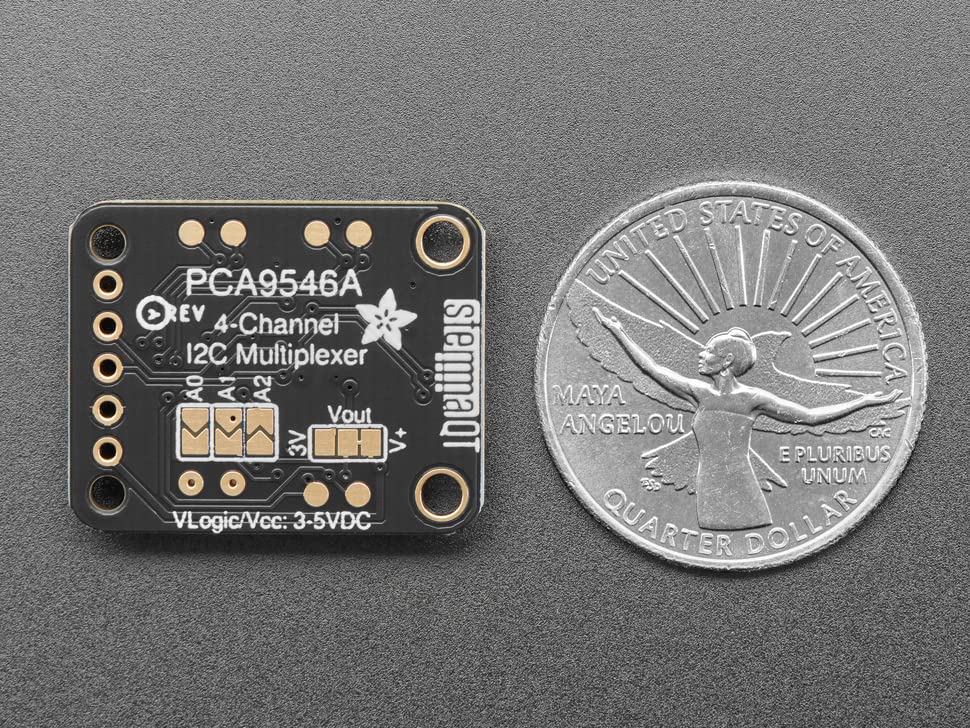
- The use is pretty straightforward: the multiplexer itself is located on the I2C address 0x70 (but can be set with jumpers on the back from 0x70 to 0x77) and you simply write a single byte with the desired multiplexed output number to this port and bam - all future I2C packets will be sent to that port. Theoretically, you could have 8 of these multiplexers on each of the 0x70-0x77 addresses to control 4x8 = 32 of the same I2C addressed part.
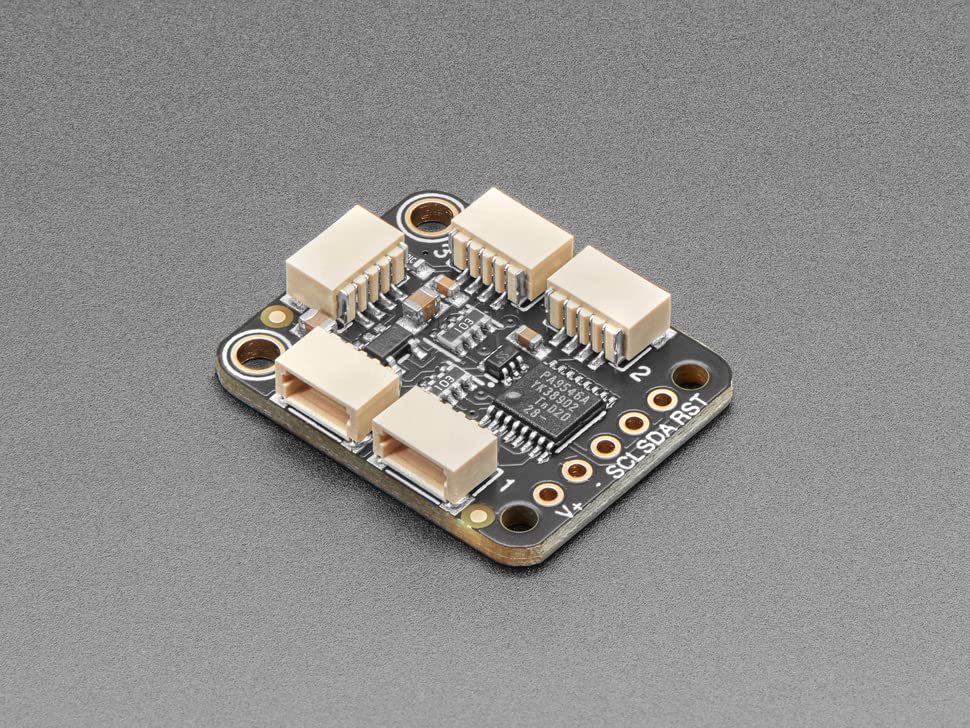
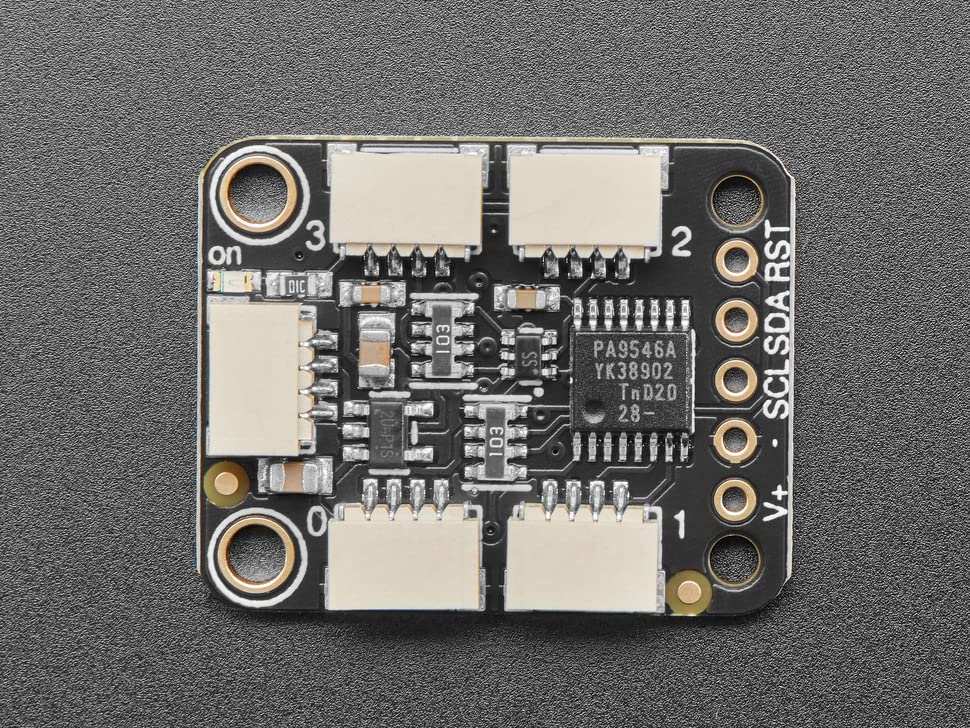
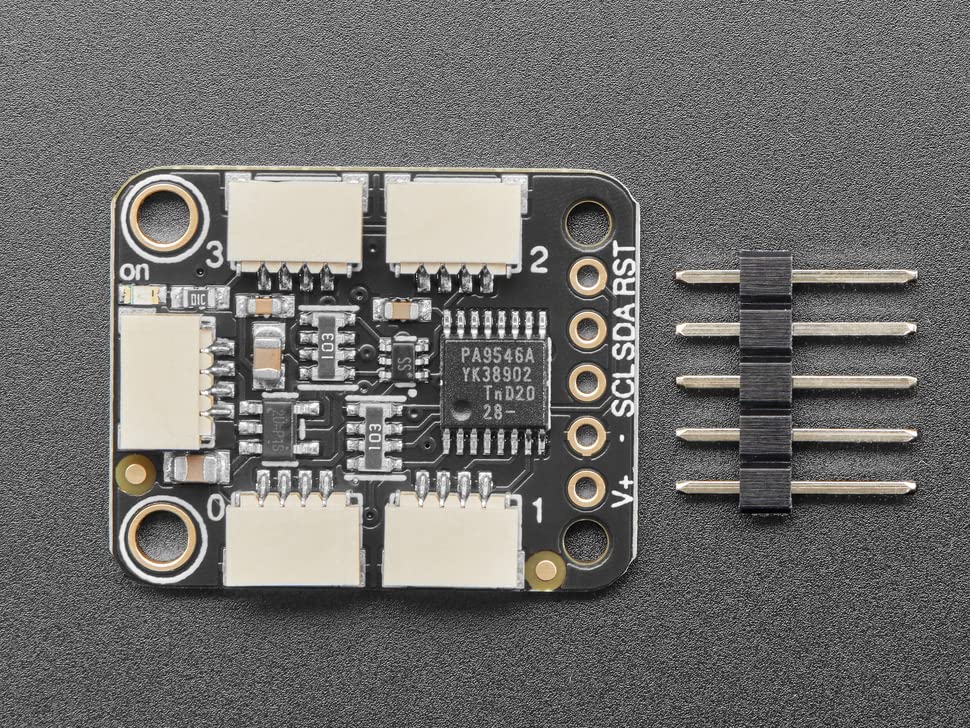
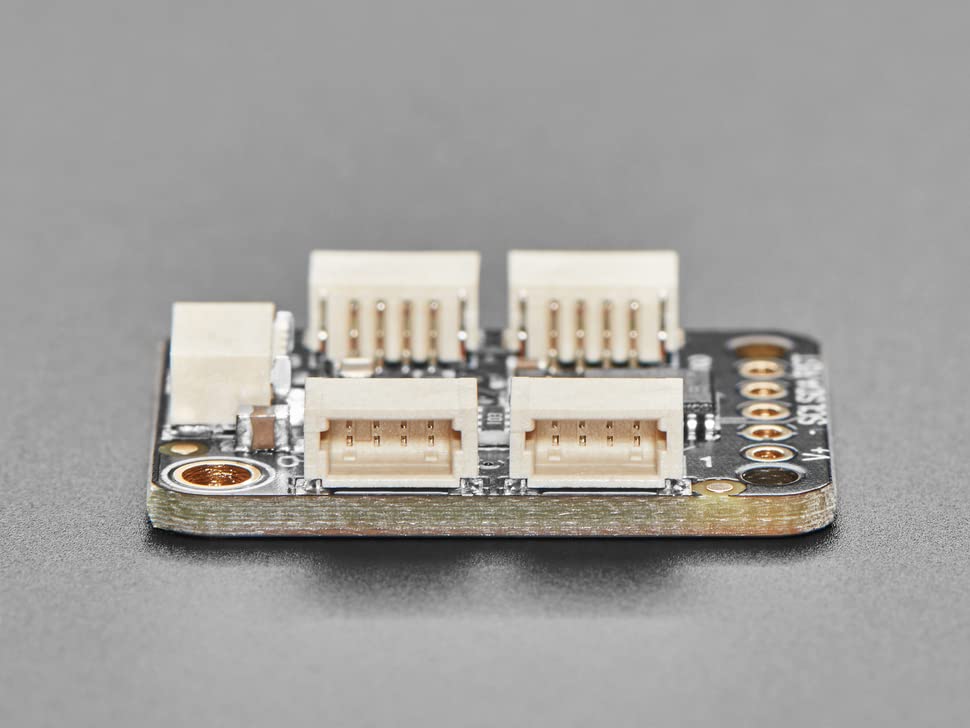
- The Adafruit STEMMA QT / Qwiic PCA9546 breakout - 4 channels has five JST SH 1mm connectors: 1 input and 4 outputs. There is a connector at the end that connects to your I2C controller (there are also breadboard breakout pins if you need them). Use this breakout to add as many I2C devices to the bus as you need. Complete with mounting holes so the board can be adapted to any system. A small power LED lets you know that the hub board has connectivity.
- There is even a built-in 3.3V 500mA regulator. So if you use this with a 5V microcontroller like an Arduino 328, you can move all QT ports to 3V power and logic level. Simply trim/solder the jumper on the bottom of the PCB to change the power and logic level to force 3V.
Original: $92.72
-65%$92.72
$32.45More Images
PCA9546 4-Channel Stemma QT/Qwiic I2C Multiplexer - TCA9546A Compatible Ada 5664
PCA9546 4-Channel Stemma QT/Qwiic I2C Multiplexer - TCA9546A Compatible Ada 5664
You've just found the perfect I2C sensor available in a handy Qwiic or STEMMA QT package, and you want to connect two or three or four of them to your microcontroller when you realize, "Uh oh, this chip has a fixed I2C address, and from what I know about I2C, you can't have two devices with the same address on the same SDA/. SCL-Pins have en!" Are you without luck? You would be if you didn't have this ultra-cool Adafruit PCA9546 4-channel STEMMA QT / Qwiic I2C multiplexer. Finally, one way is to get up to 4 I2C devices with the same address connected to a microcontroller - this multiplexer acts as a gatekeeper that routes the commands with your command to the selected I2C port. If you need to have up to 8 multiplex devices, check out the 8-channel PCA9548 version of this board. If you're wondering why this uses the PCA9546 and not the TCA9546A, the PCA9546 is the "Braternal Twin Sister" of the TCA9546, but is easier to get during the big chip shortage of 2022. It works exactly the same, just can't sink to 1.8V power, which is fine because QT boards are only 3V or 5V anyway. You can still use any sample code or library for the TCA9546 or TCA9548. The use is pretty straightforward: the multiplexer itself is located on the I2C address 0x70 (but can be adjusted from 0x70 to 0x77 with jumpers on the back) and you simply write a single byte with the desired multiplexte with the desired multiplext. ED output number to this port and Bam - all future I2C packets will be sent to this port. Theoretically, you could have 8 of these multiplexers on each of the 0x70-0x77 addresses to control 4x8 = 32 of the same I2C addressed part. The Adafruit STEMMA QT / Qwiic PCA9546 Breakout - 4 Channels has five JST SH 1mm ports: 1 input and 4 outputs. There is a connector at the end that connects to your I2C controller (there are also breadboard breakout pins if you need them). Use this breakout to add as many I2C devices to the bus as you need. Complete with mounting holes so the board can be adapted to any system. A small power LED lets you know that the hub board has connectivity. There is even a built-in 3.3V 500mA regulator. So if you use this with a 5V microcontroller like an Arduino 328, you can move all QT ports to 3V power and logic level. Simply trim/solder the jumper on the bottom of the PCB to change the power and logic level to force 3V.
Product Features
- You've just found the perfect I2C sensor available in a handy Qwiic or STEMMA QT package, and you want to connect two or three or four of them to your microcontroller when you realize, "Uh oh, this chip has a fixed I2C address, and from what I know about I2C, you can't have two devices with the same address on the same SDA/. SCL-Pins have en!" Are you without luck? You would be if you didn't have this ultra-cool Adafruit PCA9546 4-channel STEMMA QT / Qwiic I2C multiplexer
- Finally, one way is to get up to 4 I2C devices with the same address connected to a microcontroller - this multiplexer acts as a gatekeeper that routes the commands with your command to the selected I2C port. If you need to have up to 8 multiplex devices, check out the 8-channel PCA9548 version of this board.
- If you're wondering why this uses the PCA9546 and not the TCA9546A, the PCA9546 is the "Braternal Twin Sister" of the TCA9546, but is easier to get during the big chip shortage of 2022. It works exactly the same, just can't sink to 1.8V power, which is fine because QT boards are only 3V or 5V anyway. You can still use any sample code or library for the TCA9546 or TCA9548
- The use is pretty straightforward: the multiplexer itself is located on the I2C address 0x70 (but can be set with jumpers on the back from 0x70 to 0x77) and you simply write a single byte with the desired multiplexed output number to this port and bam - all future I2C packets will be sent to that port. Theoretically, you could have 8 of these multiplexers on each of the 0x70-0x77 addresses to control 4x8 = 32 of the same I2C addressed part.
- The Adafruit STEMMA QT / Qwiic PCA9546 breakout - 4 channels has five JST SH 1mm connectors: 1 input and 4 outputs. There is a connector at the end that connects to your I2C controller (there are also breadboard breakout pins if you need them). Use this breakout to add as many I2C devices to the bus as you need. Complete with mounting holes so the board can be adapted to any system. A small power LED lets you know that the hub board has connectivity.
- There is even a built-in 3.3V 500mA regulator. So if you use this with a 5V microcontroller like an Arduino 328, you can move all QT ports to 3V power and logic level. Simply trim/solder the jumper on the bottom of the PCB to change the power and logic level to force 3V.
Product Information
Product Information
Shipping & Returns
Shipping & Returns
Description
PCA9546 4-Channel Stemma QT/Qwiic I2C Multiplexer - TCA9546A Compatible Ada 5664
You've just found the perfect I2C sensor available in a handy Qwiic or STEMMA QT package, and you want to connect two or three or four of them to your microcontroller when you realize, "Uh oh, this chip has a fixed I2C address, and from what I know about I2C, you can't have two devices with the same address on the same SDA/. SCL-Pins have en!" Are you without luck? You would be if you didn't have this ultra-cool Adafruit PCA9546 4-channel STEMMA QT / Qwiic I2C multiplexer. Finally, one way is to get up to 4 I2C devices with the same address connected to a microcontroller - this multiplexer acts as a gatekeeper that routes the commands with your command to the selected I2C port. If you need to have up to 8 multiplex devices, check out the 8-channel PCA9548 version of this board. If you're wondering why this uses the PCA9546 and not the TCA9546A, the PCA9546 is the "Braternal Twin Sister" of the TCA9546, but is easier to get during the big chip shortage of 2022. It works exactly the same, just can't sink to 1.8V power, which is fine because QT boards are only 3V or 5V anyway. You can still use any sample code or library for the TCA9546 or TCA9548. The use is pretty straightforward: the multiplexer itself is located on the I2C address 0x70 (but can be adjusted from 0x70 to 0x77 with jumpers on the back) and you simply write a single byte with the desired multiplexte with the desired multiplext. ED output number to this port and Bam - all future I2C packets will be sent to this port. Theoretically, you could have 8 of these multiplexers on each of the 0x70-0x77 addresses to control 4x8 = 32 of the same I2C addressed part. The Adafruit STEMMA QT / Qwiic PCA9546 Breakout - 4 Channels has five JST SH 1mm ports: 1 input and 4 outputs. There is a connector at the end that connects to your I2C controller (there are also breadboard breakout pins if you need them). Use this breakout to add as many I2C devices to the bus as you need. Complete with mounting holes so the board can be adapted to any system. A small power LED lets you know that the hub board has connectivity. There is even a built-in 3.3V 500mA regulator. So if you use this with a 5V microcontroller like an Arduino 328, you can move all QT ports to 3V power and logic level. Simply trim/solder the jumper on the bottom of the PCB to change the power and logic level to force 3V.
Product Features
- You've just found the perfect I2C sensor available in a handy Qwiic or STEMMA QT package, and you want to connect two or three or four of them to your microcontroller when you realize, "Uh oh, this chip has a fixed I2C address, and from what I know about I2C, you can't have two devices with the same address on the same SDA/. SCL-Pins have en!" Are you without luck? You would be if you didn't have this ultra-cool Adafruit PCA9546 4-channel STEMMA QT / Qwiic I2C multiplexer
- Finally, one way is to get up to 4 I2C devices with the same address connected to a microcontroller - this multiplexer acts as a gatekeeper that routes the commands with your command to the selected I2C port. If you need to have up to 8 multiplex devices, check out the 8-channel PCA9548 version of this board.
- If you're wondering why this uses the PCA9546 and not the TCA9546A, the PCA9546 is the "Braternal Twin Sister" of the TCA9546, but is easier to get during the big chip shortage of 2022. It works exactly the same, just can't sink to 1.8V power, which is fine because QT boards are only 3V or 5V anyway. You can still use any sample code or library for the TCA9546 or TCA9548
- The use is pretty straightforward: the multiplexer itself is located on the I2C address 0x70 (but can be set with jumpers on the back from 0x70 to 0x77) and you simply write a single byte with the desired multiplexed output number to this port and bam - all future I2C packets will be sent to that port. Theoretically, you could have 8 of these multiplexers on each of the 0x70-0x77 addresses to control 4x8 = 32 of the same I2C addressed part.
- The Adafruit STEMMA QT / Qwiic PCA9546 breakout - 4 channels has five JST SH 1mm connectors: 1 input and 4 outputs. There is a connector at the end that connects to your I2C controller (there are also breadboard breakout pins if you need them). Use this breakout to add as many I2C devices to the bus as you need. Complete with mounting holes so the board can be adapted to any system. A small power LED lets you know that the hub board has connectivity.
- There is even a built-in 3.3V 500mA regulator. So if you use this with a 5V microcontroller like an Arduino 328, you can move all QT ports to 3V power and logic level. Simply trim/solder the jumper on the bottom of the PCB to change the power and logic level to force 3V.