Adafruit Silicon MEMS Microphone Breakout - SPW2430
Adafruit Silicon MEMS Microphone Breakout - SPW2430
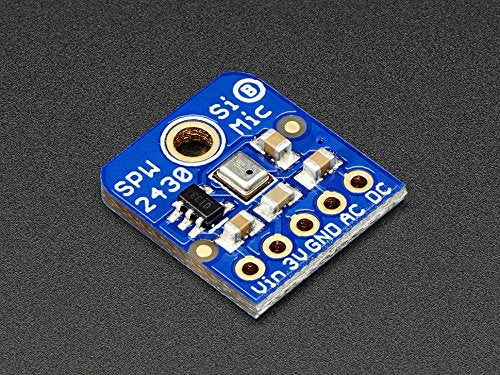
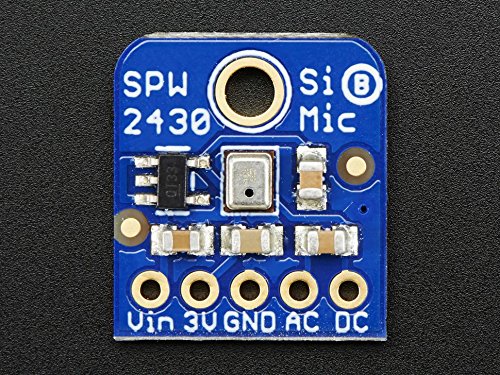
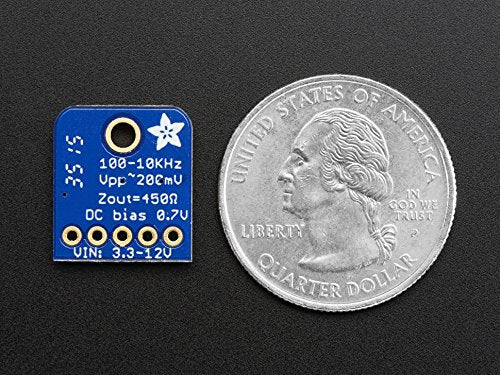
Listen to this good news – we now have a breakout board for a super tiny MEMS Microphone. Just like & 39; classic & 39; Electret Microphones, MEMS microphones can detect sound and convert it to voltage, but they don & 39; t need a bias resistor or amplifier, its all in one. The SPW2430 is a small, low cost MEMS MIC WITH A RANGE OF 100 Hz – kHz, good for just about all general audio recording/motion detection. This breakout is best used for projects such as voice changers, audio recording/sampling, and audio reactive projects that use FFT. To keep the breakout Small and simple, we only added a 3 V Voltage Regulator (the microphone requires 3.3 V DC) and filter capacitors. No additional opamp is included, the output peak to peak output voltage has a 0.67 V DC bias and about 100mVpp (peak to peak) when talking near the microphone, which is good for attaching to something that expects & 39; LINE LEVEL & 39; Input without clipping. The peak to peak output can be as high as 1Vpp if there & 39; s a very loud sound. If you are if you need a microphone with adjustable gain or auto gain control, check out our mic + amplifier options. If you need a higher peak to peak, a rail to rail op amp and some resistors can get you boosted up. 'Using it is simple: Connect GND to ground, Vin to 3.3 – 5Vdc. For the best performance, use the "quietest supply available (on an Arduino, this would be the 3.3 V supply). The audio waveform will come out of the DC pin. The output will have a DC bias of 0.67 V so when its perfectly quiet that & 39; s what you & 39; ll read, there & 39; s a little drift. If the audio equipment you & 39; re using requires AC coupled audio, you can grab the signal out of the AC Pin, which has a 10uF Capacitor in series. The output pin is not designed to drive speakers or anything but the smallest in-ear headphones – You & 39; ll need to audio amplifier such as our 3.7 W stereo amp), if you want to connect the amp directly to speakers. If you & 39; re con
Product Features
- Adafruit part number: 2716
- Stock Type: Sensor > > sound noise
- Stock in the UK/European Lager
- In stock & ready to send
- Free shipping
Original: $94.89
-65%$94.89
$33.21More Images
Adafruit Silicon MEMS Microphone Breakout - SPW2430
Adafruit Silicon MEMS Microphone Breakout - SPW2430
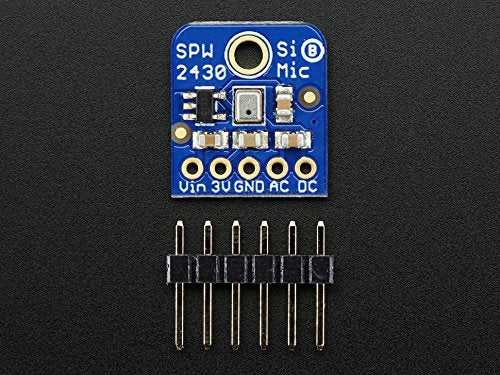
Listen to this good news – we now have a breakout board for a super tiny MEMS Microphone. Just like & 39; classic & 39; Electret Microphones, MEMS microphones can detect sound and convert it to voltage, but they don & 39; t need a bias resistor or amplifier, its all in one. The SPW2430 is a small, low cost MEMS MIC WITH A RANGE OF 100 Hz – kHz, good for just about all general audio recording/motion detection. This breakout is best used for projects such as voice changers, audio recording/sampling, and audio reactive projects that use FFT. To keep the breakout Small and simple, we only added a 3 V Voltage Regulator (the microphone requires 3.3 V DC) and filter capacitors. No additional opamp is included, the output peak to peak output voltage has a 0.67 V DC bias and about 100mVpp (peak to peak) when talking near the microphone, which is good for attaching to something that expects & 39; LINE LEVEL & 39; Input without clipping. The peak to peak output can be as high as 1Vpp if there & 39; s a very loud sound. If you are if you need a microphone with adjustable gain or auto gain control, check out our mic + amplifier options. If you need a higher peak to peak, a rail to rail op amp and some resistors can get you boosted up. 'Using it is simple: Connect GND to ground, Vin to 3.3 – 5Vdc. For the best performance, use the "quietest supply available (on an Arduino, this would be the 3.3 V supply). The audio waveform will come out of the DC pin. The output will have a DC bias of 0.67 V so when its perfectly quiet that & 39; s what you & 39; ll read, there & 39; s a little drift. If the audio equipment you & 39; re using requires AC coupled audio, you can grab the signal out of the AC Pin, which has a 10uF Capacitor in series. The output pin is not designed to drive speakers or anything but the smallest in-ear headphones – You & 39; ll need to audio amplifier such as our 3.7 W stereo amp), if you want to connect the amp directly to speakers. If you & 39; re con
Product Features
- Adafruit part number: 2716
- Stock Type: Sensor > > sound noise
- Stock in the UK/European Lager
- In stock & ready to send
- Free shipping
Product Information
Product Information
Shipping & Returns
Shipping & Returns
Description
Adafruit Silicon MEMS Microphone Breakout - SPW2430
Listen to this good news – we now have a breakout board for a super tiny MEMS Microphone. Just like & 39; classic & 39; Electret Microphones, MEMS microphones can detect sound and convert it to voltage, but they don & 39; t need a bias resistor or amplifier, its all in one. The SPW2430 is a small, low cost MEMS MIC WITH A RANGE OF 100 Hz – kHz, good for just about all general audio recording/motion detection. This breakout is best used for projects such as voice changers, audio recording/sampling, and audio reactive projects that use FFT. To keep the breakout Small and simple, we only added a 3 V Voltage Regulator (the microphone requires 3.3 V DC) and filter capacitors. No additional opamp is included, the output peak to peak output voltage has a 0.67 V DC bias and about 100mVpp (peak to peak) when talking near the microphone, which is good for attaching to something that expects & 39; LINE LEVEL & 39; Input without clipping. The peak to peak output can be as high as 1Vpp if there & 39; s a very loud sound. If you are if you need a microphone with adjustable gain or auto gain control, check out our mic + amplifier options. If you need a higher peak to peak, a rail to rail op amp and some resistors can get you boosted up. 'Using it is simple: Connect GND to ground, Vin to 3.3 – 5Vdc. For the best performance, use the "quietest supply available (on an Arduino, this would be the 3.3 V supply). The audio waveform will come out of the DC pin. The output will have a DC bias of 0.67 V so when its perfectly quiet that & 39; s what you & 39; ll read, there & 39; s a little drift. If the audio equipment you & 39; re using requires AC coupled audio, you can grab the signal out of the AC Pin, which has a 10uF Capacitor in series. The output pin is not designed to drive speakers or anything but the smallest in-ear headphones – You & 39; ll need to audio amplifier such as our 3.7 W stereo amp), if you want to connect the amp directly to speakers. If you & 39; re con
Product Features
- Adafruit part number: 2716
- Stock Type: Sensor > > sound noise
- Stock in the UK/European Lager
- In stock & ready to send
- Free shipping